


Biofuel Feedstocks: From Corn and Sugarcane to Waste Materials
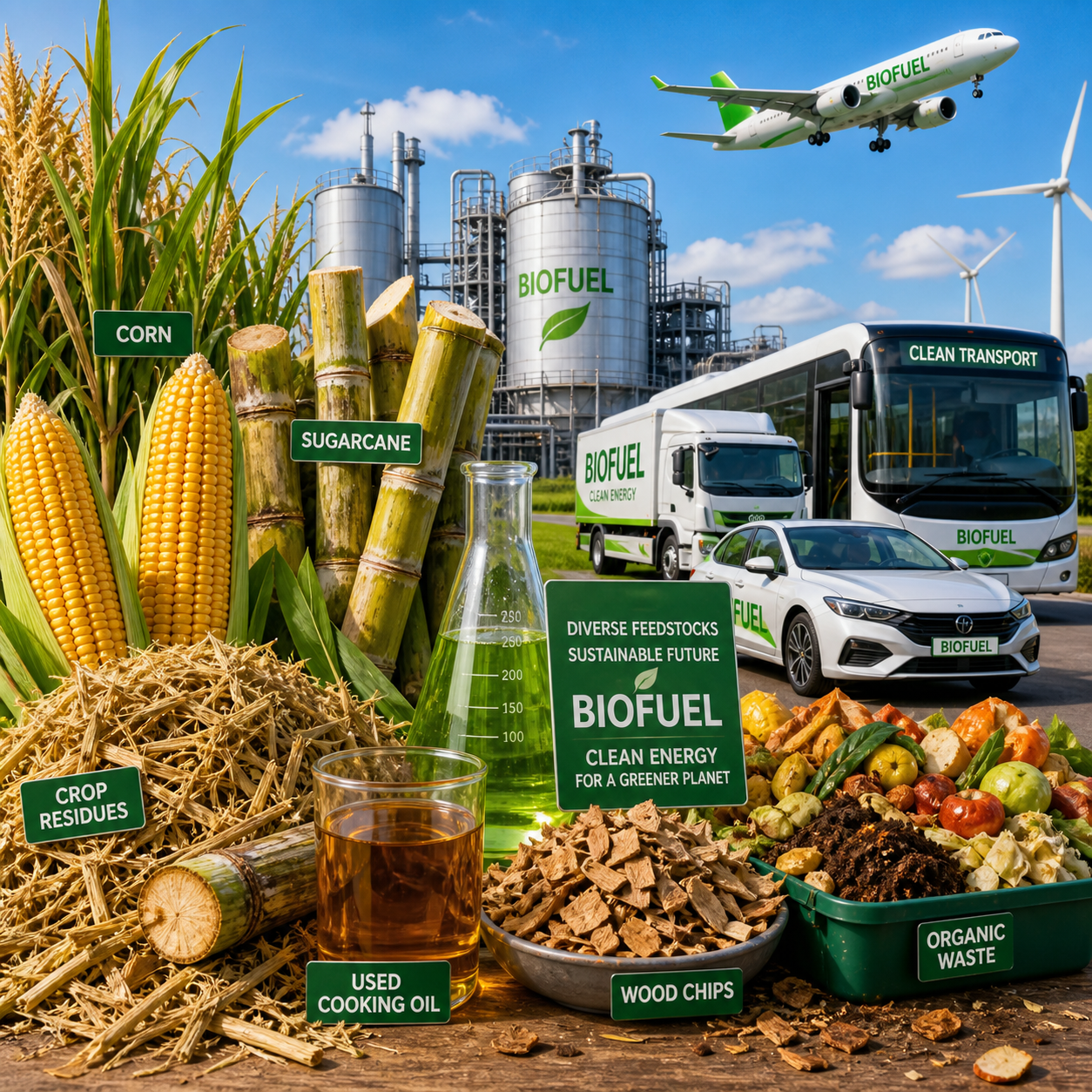
Biofuel feedstocks are the raw biological materials used to make fuels for cars, trucks, ships, and aircraft. They range from familiar crops such as corn and sugarcane to agricultural residues, forestry waste, used cooking oil, animal fats, and municipal organic waste.
The choice of feedstock influences nearly every stage of production: the conversion technology, fuel type, cost, land and water requirements, logistics, and lifecycle greenhouse-gas emissions. Understanding those connections helps explain why clean transport depends on a portfolio of biofuel sources rather than one universal solution.
What Are Biofuel Feedstocks?
Biofuel feedstocks are plant-based, animal-based, or organic waste materials converted into fuels such as ethanol, biodiesel, renewable diesel, biogas, and sustainable aviation fuel. Their chemical composition determines which processing route is practical and how sustainable the resulting fuel may be.
Sugars and starches can be fermented into ethanol. Oils and fats can be processed into biodiesel or renewable diesel. Cellulose, hemicellulose, and lignin in woody material require more complex pretreatment and conversion. Wet organic waste is often suited to anaerobic digestion, which produces biogas that can be upgraded to renewable natural gas.
A useful way to assess a feedstock is the four-part filter:
- Composition: Does it contain fermentable sugars, starch, lipids, or fibrous material?
- Availability: Is the material reliably available near a processing facility?
- Conversion: Can existing technology process it at commercial scale?
- Consequences: What are the effects on land, water, food security, biodiversity, and emissions?
A feedstock may be technically suitable yet commercially difficult. For example, scattered crop residues can be abundant across a region but expensive to collect, dry, store, and transport. That distinction between theoretical supply and usable supply is central to realistic biofuel planning.
Conventional Crop-Based Feedstocks: Corn and Sugarcane
Corn and sugarcane are conventional, or first-generation, feedstocks mainly used to produce ethanol through fermentation. Sugarcane generally supplies readily fermentable sugars, while corn is milled to release starch that enzymes convert into sugar before fermentation.
Corn ethanol is especially important in the United States, where an established farming, rail, storage, and refinery network supports large-scale production. The process also produces valuable co-products, including distillers grains used in animal feed and captured carbon dioxide in some facilities.
Sugarcane ethanol has a strong regional role in Brazil. The crop stores sugar directly in its stalk, reducing the need for starch conversion. Sugarcane processing also generates bagasse, a fibrous residue that can provide process heat and electricity or serve as a cellulosic feedstock.
| Feedstock | Primary fuel | Key advantage | Main concern |
|---|---|---|---|
| Corn | Ethanol | Established supply chains and processing infrastructure | Food-market links, fertilizer use, and land demand |
| Sugarcane | Ethanol | High sugar content and useful bagasse residue | Land-use change, water demand, and regional concentration |
Neither crop is automatically low-carbon. Results depend on farming practices, fertilizer use, energy sources at the refinery, transport distance, and whether new cultivation causes land-use change. Crop-based ethanol can support lower-carbon transport, but its sustainability depends on how the full lifecycle is managed.
Choosing crops for fuel can also create competition with food, animal feed, and ecosystems. Better yields, cover crops, precision fertilizer application, and use of processing co-products can reduce pressure, yet these improvements do not remove every land-use trade-off.
Oil-Based Feedstocks for Biodiesel and Renewable Diesel
Oil-based feedstocks such as vegetable oils, used cooking oil, and animal fats can produce biodiesel or renewable diesel. Waste-derived oils and fats often offer stronger resource-efficiency benefits than virgin oils, although their supply is limited and demand is growing.
Vegetable oils may come from crops such as soybean, rapeseed, canola, sunflower, or palm. Biodiesel is commonly made through transesterification, producing fatty acid esters for diesel engines. Renewable diesel uses hydrotreating and produces a hydrocarbon fuel that can generally be blended at higher levels and used in existing diesel infrastructure, subject to fuel standards and manufacturer requirements.
Used cooking oil and animal fats are attractive because they reuse materials already generated by restaurants, food processors, rendering plants, and households. They can avoid some cultivation-related impacts, but collection, filtration, contamination, and fraud prevention add operational challenges.
- Virgin oils provide predictable quality and larger established supply chains.
- Used cooking oil can have favorable lifecycle characteristics but is geographically dispersed.
- Animal fats can be valuable waste resources, although availability depends on livestock and rendering activity.
- Overusing waste oils for fuel may divert them from existing industrial or feed applications.
Feedstock traceability matters. A certification system or regulatory framework may be needed to confirm that a material is genuinely waste-derived and that its use does not cause indirect land-use pressure. This is particularly important when fuels receive low-carbon credits.
Cellulosic and Agricultural Residues
Cellulosic biomass includes straw, corn stover, husks, bagasse, grasses, and other non-food plant material that can support advanced biofuels. These materials can be converted into cellulosic ethanol, renewable natural gas, synthetic fuels, or intermediates for sustainable aviation fuel.
Agricultural residues contain structural carbohydrates locked inside tough plant fibers. Pretreatment opens that structure, enzymes release sugars, and microorganisms or chemical catalysts convert them into fuel molecules. Thermochemical routes can instead use heat and limited oxygen to produce syngas or bio-oil for further upgrading.
The sustainability advantage is clear: residues do not require a separate food crop and can increase the value obtained from existing harvests. The limits are practical. Farmers need some residues to protect soil, return nutrients, and control erosion. Removing too much can reduce soil organic carbon and increase fertilizer requirements.
Collection economics also shape feasibility. A refinery needs dependable volumes, but residues are seasonal, bulky, and costly to move when they contain substantial moisture. Densification, local preprocessing, satellite depots, and contracts with farmers can help, though each adds capital or coordination requirements.
Bagasse is an unusual case because it is already concentrated at sugar mills. That location advantage can make it easier to use than field-collected straw. Still, burning bagasse for process energy may compete with its use as a feedstock, so facilities must balance electricity, heat, and fuel production.
Forestry, Municipal, and Industrial Waste Materials
Forestry residues, municipal organic waste, and industrial by-products can supply biogas, renewable fuels, and advanced biofuel intermediates without relying exclusively on purpose-grown crops. Their value often comes from managing a waste problem while recovering energy.
Forestry residues include branches, tops, bark, sawdust, and mill residues. Clean woody material can be chipped, pelletized, gasified, or processed through pyrolysis. However, not every forest material should be removed. Deadwood and some residues support soil health, habitat, and nutrient cycling, while steep terrain can make collection uneconomic.
Municipal organic waste includes food scraps, yard trimmings, and other biodegradable materials. Anaerobic digesters convert this wet feedstock into biogas, which can be burned for electricity and heat or upgraded to biomethane for vehicle fuel. Capturing methane from wastewater treatment and landfills can also reduce emissions, but prevention and recycling remain higher priorities where feasible.
Industrial by-products may include brewery waste, food-processing residues, waste fats, black liquor, and other organic streams. Their composition is often more consistent than household waste, making them easier to process. Contaminants, competing uses, and contractual access still determine whether a project works.
Waste-based feedstocks are not limitless. Regional supply maps, contamination testing, transport costs, and competing markets should be completed before a facility is designed. A material that looks abundant nationally may be unavailable within the economically practical collection radius of one plant.
Comparing Feedstocks: Sustainability, Availability, and Transport Value
The best feedstock depends on the intended fuel, local resources, and lifecycle performance. Compare options across land use, water demand, emissions, logistics, processing complexity, scalability, and compatibility with the transport application.
| Criterion | Questions to ask |
|---|---|
| Land and water | Does production require new cropland, irrigation, or habitat conversion? |
| Lifecycle emissions | How do farming, collection, processing, transport, combustion, and land-use change affect total emissions? |
| Logistics | Is the feedstock dense, seasonal, wet, contaminated, or widely dispersed? |
| Conversion | Can existing equipment process it, or is expensive pretreatment required? |
| Scale | Is the supply reliable enough for a large refinery over many years? |
| Transport fit | Does the resulting fuel suit road vehicles, marine engines, or aviation? |
Crop sugars and starches are comparatively easy to ferment, while cellulosic biomass requires more complex conversion. Oils and fats are well suited to biodiesel and renewable diesel. Wet organic waste fits anaerobic digestion, and woody materials can support gasification, pyrolysis, or advanced aviation-fuel pathways.
For aviation, energy density and drop-in compatibility matter. Sustainable aviation fuel can be made from used cooking oil, animal fats, certain crop oils, municipal waste, agricultural residues, and woody biomass through approved pathways. Certification, hydrogen demand, feedstock traceability, and fuel quality are as important as raw material availability.
A practical decision rule is to prioritize low-risk local resources first, then test whether the conversion pathway and end-use provide a credible emissions benefit. A cheap feedstock that requires long-distance transport or causes significant land-use change may perform worse than a smaller local waste stream.
The Future of Biofuel Feedstocks
The future of biofuel feedstocks will depend on diversified portfolios, better waste collection, improved conversion technologies, and responsible sourcing. No single category can meet every clean-transport requirement or provide unlimited low-carbon fuel.
First-generation crops will likely remain part of the market where farming productivity, regulations, and lifecycle performance support them. At the same time, cellulosic biomass, agricultural residues, forestry residues, used cooking oil, animal fats, and municipal organic waste can expand supply without requiring equivalent growth in dedicated energy crops.
Progress will come from matching material to place and process. A sugar mill may use bagasse for heat and cellulosic fuel. A city may send food waste to an anaerobic digester. A refinery near food processors may aggregate waste fats. A forest-products region may support advanced fuels from mill residues while retaining enough biomass for ecological functions.
Better measurement will shape investment. Producers and regulators increasingly need transparent accounting for soil carbon, indirect land-use change, methane capture, fertilizer emissions, transport distance, and co-product allocation. Responsible sourcing is a condition of credibility, not a marketing detail.
Frequently Asked Questions
What is the difference between first- and second-generation biofuel feedstocks?
First-generation feedstocks are mainly food crops such as corn, sugarcane, vegetable oils, and starches. Second-generation feedstocks are non-food materials such as cellulosic biomass, agricultural residues, forestry residues, and some waste streams. Second-generation fuels can reduce food competition, but their conversion and collection systems are often more complex.
Are waste-based feedstocks more sustainable than food crops?
Often, but not automatically. Waste-based feedstocks can avoid dedicated cultivation and reduce disposal emissions, yet they may have limited supply, contamination, transport burdens, or competing uses. A lifecycle assessment should examine the specific material and location.
Which feedstocks are used to produce sustainable aviation fuel?
Sustainable aviation fuel can use used cooking oil, animal fats, certain vegetable oils, municipal waste, agricultural residues, forestry residues, and other approved pathways. The right choice depends on certification, conversion technology, hydrogen availability, fuel quality, and lifecycle emissions.
Can agricultural and forestry residues replace crop-based feedstocks?
They can supplement and partially replace crop-based feedstocks, especially where residues are concentrated and collection is sustainable. They cannot be removed without limits because some material must remain on fields or in forests for soil health, nutrients, and habitat.
How does feedstock choice affect biofuel emissions?
Feedstock choice affects emissions through cultivation, fertilizer, land-use change, collection, processing energy, transport, methane management, and co-products. Waste and residue fuels may achieve strong reductions when responsibly sourced, while crop-based fuels can also perform well under efficient farming and low-carbon processing conditions.
Authoritative lifecycle methods and sustainability rules from agencies such as the U.S. Department of Energy Bioenergy Technologies Office and the International Energy Agency help compare these pathways on a consistent basis.